
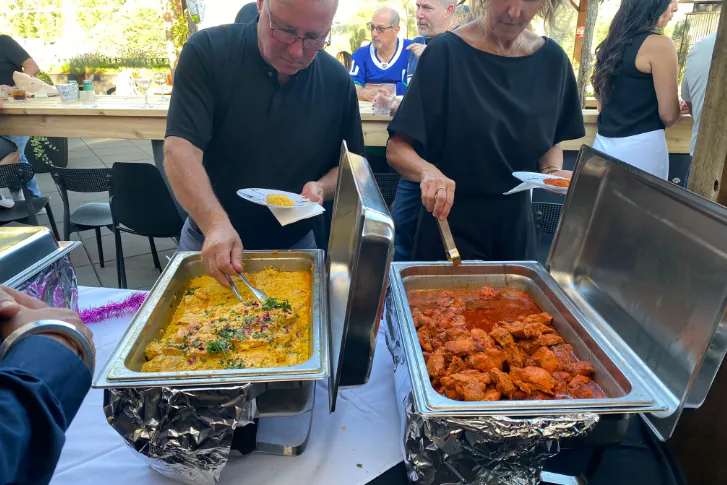
Headcount affects the food subtotal, but it also changes the service design. Twenty-five guests can often move through one compact service area without the same pressure as 200. At larger counts, arrival patterns, serving windows, staff routes, venue access, and the number of people relying on each service point become central.
This guide explains what changes in a Mehfill plan without prescribing universal tray counts, portions, or station numbers. Exact food quantities depend on the selected dishes, number of courses, service style, event length, and guest mix.
The current operating thresholds
- Standard catering: 15-guest minimum
- Live catering and Indian BBQ: 25-guest minimum
- Typical current maximum: 1,000 guests
- Live/BBQ standard team: five service staff and two cooks
- Live/BBQ above 100 guests: two additional service staff
- Estimated live-station throughput: 60–70 guests per hour per station
- Company-wide capacity: no more than six accepted catering orders per day; each accepted order uses one slot
These thresholds help screen a request. They do not replace availability, venue, menu, or quote review.
What changes at each headcount
| Guest count | Main planning shift | Questions to resolve |
|---|---|---|
| 25 guests | Most current formats become available, including live and BBQ at their minimum | Is the service complexity worthwhile for an intimate event? Does the venue fit the chosen format? |
| 50 guests | Service style, timing, and buffet or station position become more visible | Will guests arrive together? Is food the main meal or one part of the event? |
| 100 guests | Peak flow needs explicit calculation; live/BBQ still uses the standard five-plus-two team at exactly 100 | Can everyone access food within the real window? Is one service point carrying too much demand? |
| 200 guests | Multiple service paths, loading, staging, replenishment, and the run of show need early coordination | How are guests released, how long is service, and can the venue support the required layout and team? |
Planning Indian catering for 25 guests
At 25 guests, buffet, finger food, office lunch, and standard catering minimums are already met, and live catering or BBQ reaches its current minimum. The important question is whether the service format adds enough value for the occasion.
A C$13.99, C$19.99, or C$24.99 buffet framework may be a straightforward hosted-meal starting point. Live Chaat at C$50 per person or Live Tandoor at C$65 per person adds a C$100 service fee and the separately billed standard live team. For an intimate event, the staffing and production structure may be a larger share of the budget than it is at a higher headcount.
Do not assume a small guest count means no venue planning. A live station still uses equipment, approximately 40 square feet as an early station allowance, queue space, and an approved service position.
Planning Indian catering for 50 guests
At 50 guests, the event can still feel intimate, but one poorly placed buffet or station can affect the whole room. Clarify whether guests eat at once, circulate over time, or need service between scheduled moments.
For a live station, 50 guests over one hour represent an average demand of 50 guests per hour. That sits below Mehfill’s 60–70 estimate and may make one station a planning starting point. It is not a promise: menu complexity, repeat visits, and a concentrated rush can change the answer.
For a buffet, focus on where plates begin, how dishes are labelled, how guests leave the line, and how staff replenish without crossing the queue. The menu can be simple while the room still needs a clear plan.
Planning Indian catering for 100 guests
At exactly 100 guests, the live/BBQ staffing baseline remains five service staff and two cooks. Mehfill’s policy adds two service staff only when the count is above 100. Other event needs can still affect the team and billed hours, so the baseline is not a universal final staffing plan.
If all 100 guests depend on one live station during one hour, average demand is 100 guests per hour—above the single-station planning estimate. If service runs for two hours, the average becomes 50 per hour, but the first 20 or 30 minutes may still be much busier. Use the live-station demand method before assuming a station count.
At this scale, also confirm loading time, kitchen or staging access, table release, accessibility, dietary labels, and who can approve a schedule change.
Planning Indian catering for 200 guests
Two hundred guests do not automatically require one specific number of buffet lines or live stations. They do require a plan that prevents one point from becoming the only route to food. If 200 guests use a live station over two hours, average demand is 100 per hour, which is above the single-station estimate before peak concentration is considered.
At this headcount, the venue and catering plan should connect:
- guest arrival and table-release timing;
- buffet, live station, beverage, and dessert service points;
- back-of-house staging and replenishment routes;
- loading, elevator, dock, parking, and teardown windows;
- dietary communication and labels;
- staff briefing, event contacts, and decision authority;
- weather and backup plans for any outdoor service.
For live or BBQ service above 100 guests, the shared policy adds two service staff, bringing the baseline to seven service staff plus two cooks. The final plan may still require different hours, equipment, or service points.
What does not change with headcount
Some rules apply across the current range:
- Published prices are in Canadian dollars before HST.
- Standard GTA delivery is C$40 with drop-off setup.
- Live/BBQ uses one C$100 transportation, setup, teardown, and equipment fee instead of adding the C$40 fee.
- Staffing is C$18 per person per hour with a three-hour minimum and no billed travel time.
- Final menu and guest count are due 24 hours before the event under the current policy.
- All meat served is halal, without a chain-wide certification claim.
- Dietary and cross-contact questions need menu-specific confirmation.
Do not use a universal food-quantity chart
“How much food for 100 people?” cannot be answered responsibly without the menu and event. Ten dishes served as a full dinner produce a different quantity plan from three appetizers during a short reception. Children, event duration, service format, seconds, and whether other food is available all matter.
Mehfill publishes serving ranges for individual tray sizes, but those ranges do not tell you how many trays make a complete multi-dish meal. Use the Indian catering menu-planning guide to prepare the right questions, then let the kitchen build quantities around the confirmed order.
Applying the headcount plan to an office Diwali lunch
Count the people who will eat during each serving window, including colleagues on later breaks. A single company headcount can hide several separate distribution needs. Our Diwali catering ideas for offices compare buffets, labelled meals and live chaat; the Diwali office catering page covers the available package starting points and enquiry.
Information to send at any scale
- Date, address, indoor/outdoor setting, and venue contact
- Estimated guest count and deadline for the final count
- Serving window plus any moment when all guests are released together
- Menu or package direction and the role of the food
- Dietary requirements and how guests should identify suitable dishes
- Delivery, buffet, servers, live station, BBQ, or full-service preference
- Loading, setup, utilities, cooking, fire, and teardown rules that apply
Use the published package starting points for an early budget, then send the complete scope through the Indian catering quote form. A precise brief is more valuable than a precise-looking online quantity guess.
Sources and planning references
- Mehfill Indian catering service scope and minimums
- Mehfill buffet package frameworks and rates
- Mehfill live-service staffing, capacity, and package facts
- Mehfill delivery, setup, staffing, and timing terms
- Mehfill menu-planning guide
Operating facts checked August 26, 2026. Exact quantities, station counts, staffing hours, and event totals remain quote-specific.