
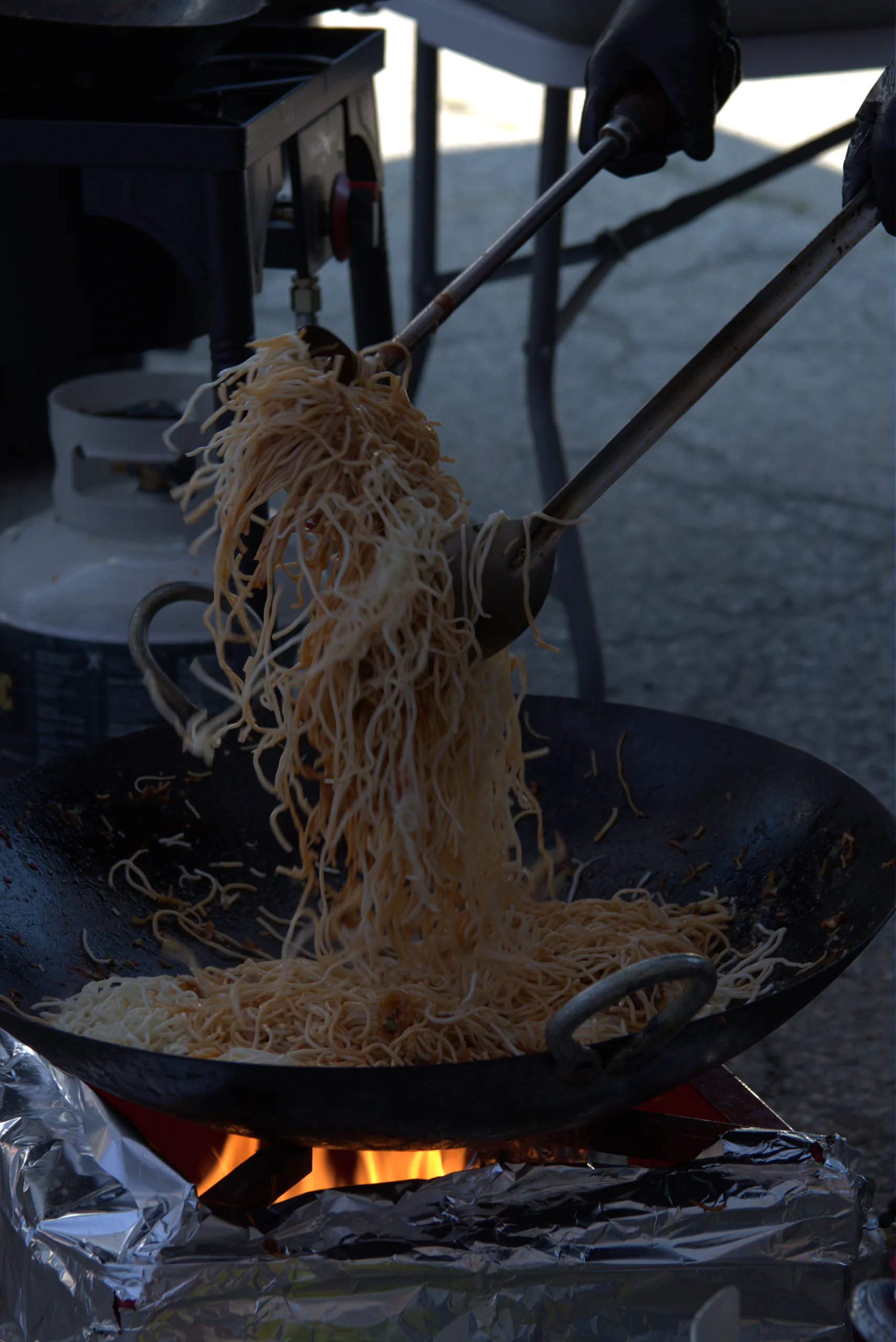
A station count should not come from headcount alone. The more useful question is: how many guests need food from this station during the busiest part of the serving window? One hundred guests spread across two hours create different pressure from one hundred guests arriving together after a speech.
Mehfill uses 60–70 guests per hour per station as an early planning estimate. It is not a service guarantee. Use it to identify whether a proposed setup is obviously under pressure, then confirm the actual recommendation against the menu, venue, event schedule, and guest flow.
The station-demand formula
Average station demand per hour = guests expected to use the station ÷ serving-window hours.
Compare that result with the 60–70 guests-per-hour-per-station estimate. If average demand is already above the estimate, one station is not a responsible assumption for feeding everyone within that window. If average demand is below it, peak arrivals can still create a queue, so the calculation is only the first screen.
Examples for 50, 100, and 200 guests
| Scenario | Average demand | What the estimate tells you |
|---|---|---|
| 50 guests over one hour | 50 guests/hour | Below the 60–70 estimate. One station may be an operational starting point, but menu and peak-arrival review still decide. |
| 100 guests over one hour | 100 guests/hour | Above a single station’s estimate. Multiple service points, a longer window, staggered service, or a supporting format likely needs discussion. |
| 100 guests over two hours | 50 guests/hour on average | Average demand appears manageable, but a concentrated post-ceremony or post-speech rush could still exceed it. |
| 200 guests over two hours | 100 guests/hour on average | Above a single station’s estimate. The quote should address multiple stations or a different service sequence. |
These examples do not prescribe “one station for X guests.” They show why both headcount and time matter. The final number can move in either direction based on what the station is producing and whether every guest depends on it.
Use peak demand when the schedule creates a rush
Average demand can hide the difficult part of the event. If dinner technically runs for two hours but almost everyone will line up during the first 30 minutes, calculate that peak separately. One hundred guests in half an hour represent a much more demanding flow than 50 guests per hour.
Ask the planner or venue when guests are released toward food. Common pressure points include the end of a ceremony, the close of cocktail time, a scheduled lunch break, and the moment speeches finish. Do not promise a short queue based only on the total event duration.
Menu complexity affects throughput
A station serving one tightly defined item is not the same as a station where every guest makes several choices, asks dietary questions, or waits for multiple components. Live Chaat invites selection and assembly; Live Tandoor has a different production rhythm. Both must be assessed against the exact menu.
Seconds matter too. If the station is an arrival feature and guests can return throughout the evening, repeat visits may be part of the experience. If it is the only dinner path, the first pass for every guest becomes the priority.
Space is part of capacity
Mehfill uses approximately 40 square feet per station as an early footprint allowance. That figure is for beginning the site conversation, not drawing the final floor plan. It does not automatically include every queue, guest-clearance, back-of-house, fire-separation, ventilation, or accessibility need.
A venue should review:
- the station footprint and approved equipment position;
- where the queue begins and how it bends;
- how guests leave without crossing those still waiting;
- clear routes to seating, exits, washrooms, and other services;
- the caterer’s loading, staging, replenishment, and waste path;
- any fire, power, ventilation, fuel, or access requirement for the confirmed format.
The live catering venue guide is the broader checklist. The City of Toronto’s event-planning guidance is also a useful starting reference for events within its scope; venue and authority requirements still control the actual site.
Staffing and station count are related, but not interchangeable
Every Mehfill live or BBQ event has a standard team of five service staff and two cooks, with two more service staff when the guest count is above 100. Staffing is billed separately at C$18 per person per hour before HST, with a three-hour minimum.
That team rule does not automatically tell you how many stations to use. More staff cannot always solve a production bottleneck, and more equipment without the right team does not create smooth service. The quote must connect people, production points, and the room.
Ways to reduce pressure without simply adding stations
- Open the station earlier and communicate the serving window clearly.
- Stagger tables or groups when the event format allows it.
- Use a supporting buffet or passed item so the live station is not the only path.
- Simplify the number of choices during the busiest interval.
- Separate ordering, assembly, and pickup when the menu and venue support it.
- Place beverages, cutlery, and condiments where they do not block food pickup.
Each option changes the guest experience. The goal is not maximum speed at any cost; it is a service rhythm appropriate for the event.
What to send for an actual recommendation
Provide the guest count, the number of guests expected to use the station, the serving start and end times, any scheduled release moment, the menu or package of interest, the floor plan, and the venue’s cooking rules. Then use the live catering enquiry to confirm station count and staffing together.
Sources and planning references
- Mehfill live package, staffing, service-window, throughput, and footprint facts
- Mehfill live catering venue-requirements guide
- City of Toronto guidance for planning events
The 60–70 guests/hour/station figure and approximately 40-square-foot footprint are planning estimates, not guarantees or final layouts.