
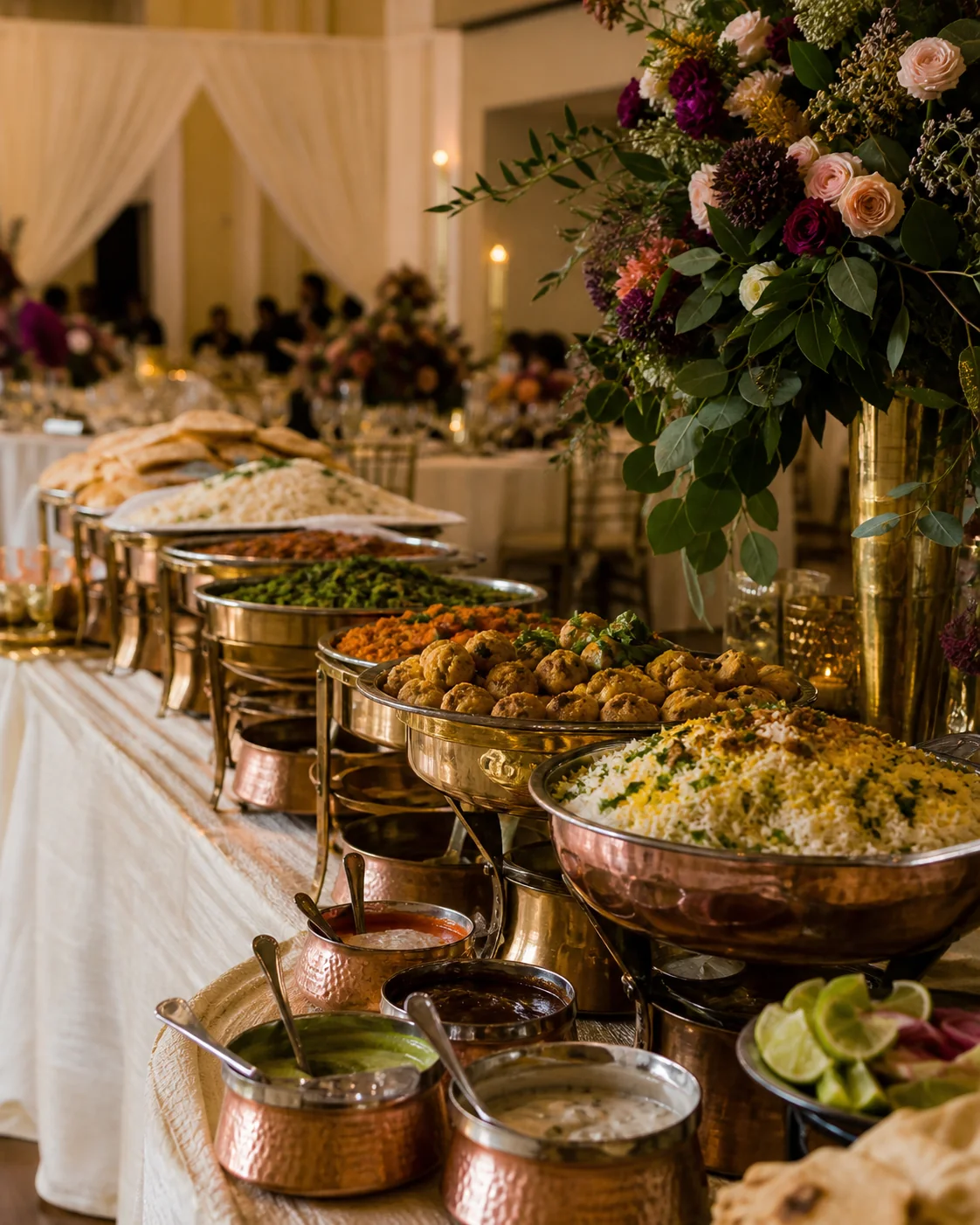
Indian wedding catering cost in Toronto is not a single per-plate number. Guest count, number of functions, buffet or live-station service, staffing, venue access, equipment, delivery, rentals, add-ons, and HST all affect the final quote. For 2027 planning, build the budget around the full catering scope, not only the food subtotal.
A useful first formula is: menu subtotal + delivery or service fee + staffing + equipment or rentals + venue requirements + add-ons + HST + any gratuity or service charge. The written quote should separate those pieces so two caterers can be compared fairly.
The short answer for 2027 wedding budgets
For a Toronto Indian wedding, start with the service style and the number of meals being catered. A simple buffet, a staffed reception buffet, a live chaat station, a live tandoor feature, and a multi-function wedding weekend are different budgets even when the guest count is the same.
Mehfill's current published anchors include buffet frameworks at C$28, C$38, and C$45 per person before HST, Live Chaat at C$50 per person, and Live Tandoor at C$65 per person. These are planning anchors, not guaranteed wedding totals. Staffing, venue requirements, add-ons, equipment, tax, and availability are confirmed in writing.
Why wedding catering costs more than the menu price
The per-person food price is only one part of a wedding catering total. A reception may also need servers, cooks, buffet attendants, live-station staff, service equipment, delivery, setup, teardown, tableware, chafers, venue coordination, and tax.
That is why two numbers can both be true: a package can start at C$45 per person before HST, while the final reception catering total is much higher once staffing, equipment, service hours, venue rules, and HST are included. Couples should ask whether a quote is food-only, food plus delivery, or fully scoped for the event.
Use guest count as the first budget filter
Guest count sets the food subtotal, but it also affects service flow. A 75-person Mehndi, a 150-person Sangeet, and a 300-person reception should not be planned from the same line item. Each meal needs its own count, serving window, and format.
| Planning example | Food-anchor calculation before HST | What still needs to be added |
|---|---|---|
| 100 guests, C$38 buffet anchor | C$3,800 | Delivery, staffing if needed, equipment, add-ons, venue needs, HST |
| 150 guests, C$45 buffet anchor | C$6,750 | Service team, rentals, setup details, late-night or dessert additions, HST |
| 200 guests, C$50 Live Chaat anchor | C$10,000 | Live-service fee, staffing, station layout, venue approval, HST |
| 200 guests, C$65 Live Tandoor anchor | C$13,000 | Live-service fee, cooks and servers, venue/fire review, equipment, HST |
These examples are not final quotes. They show why the early question should be "what catering experience are we building?" rather than only "what is the cheapest plate price?"
Choose the right service style for the wedding moment
Buffet service is often the most flexible starting point for Indian weddings because it can handle menu variety, family preferences, and larger guest counts. Live stations can make the food experience more memorable, but they also add staffing, space, equipment, and venue-permission questions.
A practical wedding plan may use different formats across the schedule. A Mehndi can use finger food or a chaat-style flow. A Sangeet can use a buffet that keeps guests moving around performances. A reception can use a fuller buffet with one feature station. The strongest budget is usually intentional, not identical at every function.
Plan each Indian wedding function separately
Multi-event Indian weddings need a connected budget. If every function receives the same premium treatment, costs rise quickly and the menu can feel repetitive. Decide which meal should feel most formal, which should be easiest to serve, and where a live station genuinely improves the guest experience.
| Function | Budget role | Common catering direction |
|---|---|---|
| Mehndi | Relaxed, social, flexible | Finger food, chaat, compact buffet |
| Sangeet | Movement-heavy, entertainment-led | Buffet, easy-to-serve menu, optional feature station |
| Ceremony meal | Timing-sensitive | Predictable buffet or packaged service plan |
| Reception | Main hospitality moment | Fuller buffet, premium menu, staffed service, live feature |
| Late night | Comfort after a long event | Simple snack, dessert, tea, or compact station |
Send all dates, venues, guest counts, and serving windows in one enquiry when possible. It helps the caterer see repetition, staffing conflicts, venue limits, and budget pressure across the full wedding plan.
Include the costs couples often miss
The most common budgeting mistake is comparing food-only numbers against full-service numbers. Ask every caterer to separate food, delivery, staffing, equipment, rentals, HST, and optional add-ons.
- Delivery, setup, teardown, and service fees
- Servers, cooks, buffet attendants, and minimum staff hours
- Chafers, serving equipment, tableware, linens, glassware, and rentals
- Venue kitchen fees, outside-caterer fees, loading, elevator, parking, and access rules
- Live-cooking requirements, power, ventilation, fire approval, and weather plans
- Dietary labels, separate meals, nut-aware requests, and allergy communication
- Dessert, tea, late-night snacks, or extra service moments
- Ontario HST and any gratuity or administrative charge
At Mehfill, standard GTA delivery is C$40 with drop-off setup. Live and BBQ catering use a C$100 total transportation, setup, teardown, and equipment fee instead of the standard delivery fee. Staffing is C$18 per staff member per hour before HST, with a three-hour minimum per person and no billed travel time.
Ask venue questions before locking the menu
Venue rules can change the catering budget. Outside-caterer policies, elevator bookings, loading dock access, approved service areas, kitchen access, power, cleanup rules, and late-night restrictions can all affect the final scope.
Live stations need extra review. Chaat may require a guest-facing station with enough queue space. Tandoor or BBQ service may require venue and fire approval, utilities, ventilation, access, and a weather backup. Do not assume a beautiful venue can support every cooking setup.
Build the quote request like a budget brief
A good quote request gives the caterer enough information to price the real event instead of guessing. Include the wedding date, each function date, full venue address, estimated guest count by function, serving window, service style, dietary notes, live-station interest, equipment needs, and the venue's outside-catering rules.
Also share what matters most: lowest practical budget, premium reception presentation, fast service, vegetarian variety, live-station theatre, late-night comfort food, or simple coordination across several family events. Clear priorities help the quote protect the experience instead of adding every possible option.
Frequently asked questions
How much is Indian wedding catering per person in Toronto?
Indian wedding catering per person in Toronto depends on menu, service style, staffing, venue rules, equipment, and tax. Use published package prices only as the food anchor. The final quote should show delivery or service fees, staff hours, rentals, add-ons, and HST separately.
Is buffet cheaper than plated service for an Indian wedding?
Buffet service is often more budget-flexible than plated service because it can serve larger groups with less table-by-table labour. Plated service can feel more formal, but it usually needs tighter timing, kitchen coordination, rentals, and service staffing. The venue and menu decide the real difference.
Do live chaat or live tandoor stations cost more?
Live stations usually cost more than simple drop-off catering because they add staff, equipment, space, setup, guest-flow planning, and venue approval. Mehfill's current public anchors are C$50 per person for Live Chaat and C$65 per person for Live Tandoor before HST and event-specific costs.
Does HST apply to wedding catering in Ontario?
Ontario uses 13% HST where applicable. Couples should ask whether quoted prices are before or after HST and whether tax applies to food, staffing, rentals, service fees, and add-ons. For tax-specific questions, use Canada Revenue Agency guidance or a qualified tax professional.
Can one caterer handle multiple Indian wedding events?
Yes, one caterer can often plan multiple wedding functions when the dates, venues, guest counts, and service windows are clear. A connected plan helps avoid repeated menus, staffing conflicts, venue surprises, and budget drift across the Mehndi, Sangeet, ceremony, reception, and late-night service.
Indian wedding catering cost Toronto couples can actually use
The most useful Indian wedding catering cost Toronto couples can build is a scoped budget, not a single plate price. Start with the guest count and food format, then add staffing, venue rules, delivery or live-service fees, equipment, HST, and function-by-function timing. When the basics are ready, send one complete wedding catering enquiry so the written quote can become the source of truth.
Sources and planning references
- Mehfill Indian wedding catering capabilities
- Mehfill buffet package frameworks and current rates
- Mehfill Live Chaat and Live Tandoor package anchors
- Mehfill delivery, setup, staffing, and timing terms
- Mehfill dietary options and safety boundaries
- Mehfill general Indian catering cost guide
- Canada Revenue Agency GST/HST rate guidance
Operating facts checked September 23, 2026. This is a 2027 planning guide, not a fixed 2027 quote. Final wedding menus, service style, staffing, venue requirements, availability, and prices are confirmed in writing.